
Nitrile Extrusions
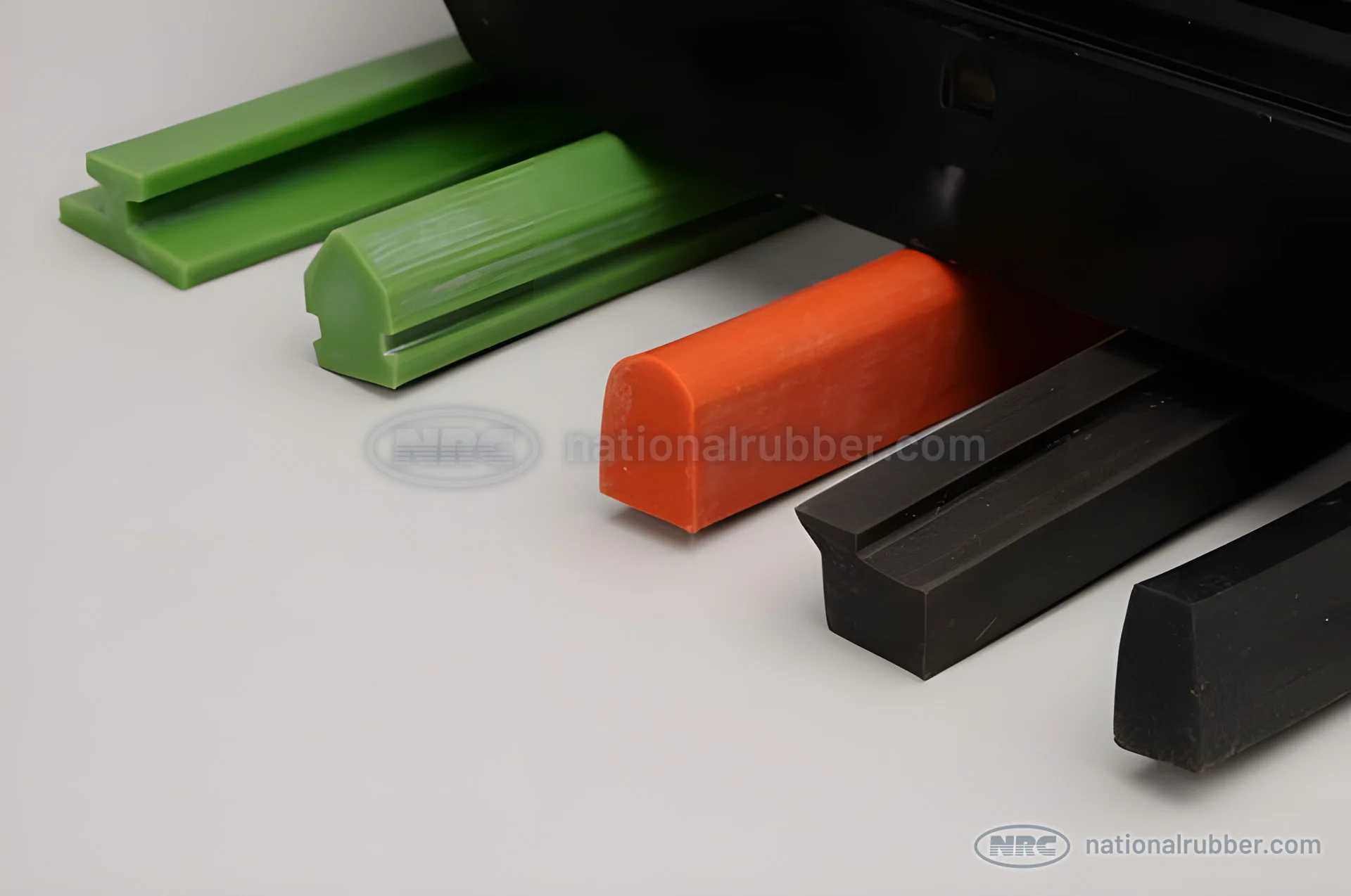
Custom nitrile (NBR, Buna-N) rubber extrusions to your drawing or sample: profiles, channels, bulb seals, tubing and cord in solid nitrile. Nitrile resists petroleum oil, fuel and hydraulic fluid, which makes it the usual rubber for seals in oil and fuel service.
Solid or sponge silicone is rated over a wider temperature range than nitrile and comes in FDA-compliant grades, and fluorosilicone keeps most of silicone’s temperature range and adds fuel and oil resistance. Tolerances are held to RMA classes: E2 is typical, and tighter on request.
Solid nitrile profiles, channels, tubing and cord. Quick lead times.
- Solid nitrile (NBR, Buna-N) profiles to your drawing
- Petroleum oil, fuel and hydraulic fluid resistance
- Silicone extrusions in FDA-compliant grades, -65 °F to +400 °F
- Fluorosilicone for fuel and oil service
- Splicing into endless rings and frames, PSA backing
- Quotes within 1-2 business days
Nitrile extrusion specifications
| Specification | Detail |
|---|---|
| Profiles | Custom cross-sections to your drawing, in inch and metric sizes |
| Channels and strips | U-, C- and H-channels; L, T and P strips; P and E weather strips (H, L, T, P and E strips) |
| Bulb, P and D seals | Hollow sealing profiles for doors, lids and hatches, to your drawing |
| Tubing and cord | Round tubing to the ID and OD on your drawing; solid cord for O-rings and splicing (Rubber tubing) |
| Material callouts | ASTM D2000 line callouts (Nitrile: BF, BG, BK, CH) (ASTM D2000 callouts) |
| Tolerances | RMA E1, E2 or E3; E2 typical, tighter on request (RMA tolerance classes) |
| Put-ups | Coils, spools or rolls, or cut to length; the coil length is stated on the quote |
| Dies | We cut our own extrusion dies; a new die is a one-time line on the quote |
| Testing and inspection | Durometer, rheometer cure, tensile and elongation testing; dimensional inspection against your drawing |
Silicone or nitrile extrusions
Silicone resists heat, cold, sunlight and ozone; nitrile resists petroleum oil and fuel. Typical published values for each material:
| Property | Silicone | Nitrile |
|---|---|---|
| Typical temperature range | -65 °F to +400 °F | -30 °F to +212 °F |
| Petroleum oils, fuels and hydraulic fluids | Not for gasoline and other fuels; fluorosilicone adds fuel and oil resistance | Resists |
| Sunlight, ozone and weathering | Resists | Standard grades do not hold up; outdoor parts need an ozone-resistant grade |
| Abrasion | Lower in general-purpose grades; high-strength grades narrow the gap | Resists |
Silicone is extruded solid 30–80 Shore A or as sponge, in red, black, white, clear, blue and grey plus orange, green and yellow, and in FDA-compliant grades. Fluorosilicone is one of the silicone types we extrude. Send one drawing and we can quote the profile in both.
Materials
Extruded in the grade, durometer and color on your drawing.
| Material | Notes |
|---|---|
| Silicone | Solid 30–80 Shore A, or sponge: soft, medium or firm. FDA-compliant and other grades |
| Nitrile (NBR) | Profiles, tubing and cord to your drawing |
Standard profiles in our catalog
Sizes with drawings and dimension tables. Any of them can be quoted in silicone or in nitrile.
Silicone extrusions
Solid and sponge silicone profiles, tubing and cord.
Other materials
Each compared with silicone.
Strips and seals
H-channels, L, T and P strips, bulb seals, P and E weather strips.
Tubing, cord and bumpers
Tubing, solid cord for O-rings, bumper strips.
Secondary operations and tooling
- Cut to length on an automatic cutter; hand-cut for fragile or short pieces
- PSA (pressure-sensitive adhesive) backing
- Splicing into endless rings and frames, with molded corners for exact-radius frames
- A new die is a one-time line on the quote; an existing profile may need no new die
- Hollow profiles run on a bridge die
What we need to quote
- A drawing (PDF), or a CAD file: DXF or STEP
- A sample part, or a sketch with dimensions
- Material, durometer and color, or the specification your drawing calls out
- Quantities: each quote gives several quantity tiers
- Any documents you need with the parts: certificate of compliance, first article, test reports
- For a nitrile profile: the cross-section with dimensions, the ASTM D2000 callout or durometer, the fluid it will see, and the cut length or coil length
Add Nitrile Extrusions to your quote
Tell us about your project. It goes into your quote with any catalog parts you add, and you send it from the quote page.
Frequently asked questions
- What do you extrude in nitrile?
- Solid nitrile profiles, channels, bulb seals, strips, tubing and cord, to your drawing, sample or sketch. Standard channels, strips and tubing are in our catalog.
- Is nitrile the same as NBR or Buna-N?
- Yes. Nitrile is acrylonitrile butadiene rubber, abbreviated NBR and also called Buna-N. A drawing may call it out by any of these names, or by an ASTM D2000 line (BF, BG, BK or CH).
- How does silicone compare with nitrile?
- Silicone is typically rated -65 °F to +400 °F, resists sunlight and ozone, and comes in FDA-compliant grades and in colors, but plain silicone is not for fuel. Nitrile is typically rated -30 °F to +212 °F and resists petroleum oil, fuel and hydraulic fluid. Fluorosilicone keeps most of silicone’s temperature range and adds fuel and oil resistance. Our silicone extrusions page lists the silicone types and durometers.
- Can nitrile extrusions be used outdoors?
- Silicone, EPDM and neoprene resist weather and ozone. Standard nitrile does not hold up well to sunlight and ozone, so an outdoor nitrile part needs an ozone-resistant grade. Tell us where the part will be used and we quote the compound with the profile.
- What tolerances do you hold?
- Each quote states an RMA tolerance class. We hold RMA E1, E2 or E3; E2 is typical, and tighter tolerances are available on request.
- Can nitrile cord and profiles be spliced into rings or frames?
- Yes. Cord and profiles are spliced and vulcanized into endless rings and frames. Frames with exact-radius corners use a one-time corner mold.
- What do you need to quote a nitrile extrusion?
- A drawing, a CAD file (DXF or STEP), a sample or a sketch of the cross-section, with the ASTM D2000 callout or durometer, the fluid the part will see and the quantity. Quotes go out within 1-2 business days.
Typical parts by industry
Extruded parts by industry, in all materials:
| Industry | Typical parts |
|---|---|
| HVAC, building and constructionConstruction industry | Profiles and strips |
| Aerospace and defenseAerospace industryDefense industry | Profiles, door and hatch seals, cord, U-channels, bulb, P and D seals |
| Electrical and electronicsElectronics industry | Strips and profiles |
| Industrial machinery | Profiles, strips, door seals, cord |
| Seal, gasket and rubber distributors | Profiles, cord, tubing, U-channels |
Where nitrile extrusions are used
Nitrile is a copolymer of butadiene and acrylonitrile, and the most common material for seals that see petroleum oil, fuel or hydraulic fluid. Typical extruded parts:
- Seals for oil, fuel and hydraulic equipment
- Gaskets for pumps, engines and gearboxes
- Seals for fuel-handling equipment
- O-rings spliced from cord for oil service
- Oil-resistant bumpers and strips
Nitrile grades and fluids to check
The acrylonitrile content sets the balance of a nitrile compound: more of it improves oil and fuel resistance, less of it improves flexibility in the cold. Name the ASTM D2000 callout on your drawing, or tell us the fluid and the temperature range the part will see.
Fluids and conditions that standard nitrile does not suit:
- Ozone, sunlight and weathering (standard grades)
- Ketones such as MEK and acetone
- Glycol-based brake fluids
- Strong acids
How to specify a nitrile extrusion
A complete callout names:
- The cross-section, fully dimensioned, with an RMA tolerance class (E1, E2 or E3)
- The material: a compound, or an ASTM D2000 line callout (BF, BG, BK or CH)
- Durometer (Shore A)
- Cut length with its tolerance class, or the coil length
- Any adhesive backing, splicing or other secondary operation
- Quantity per release and per year
Quality, documents and terms
Quality and documents
- ISO 9001:2015 certified quality system
- Certificates of compliance at no charge, on request
- First article inspection, test reports and PPAP-type documents on request where offered, quoted separately
Ordering terms
- Quotes within 1-2 business days, with several quantity tiers
- Quick lead times; the lead time is stated on every quote
- FOB Canonsburg, PA
- Tooling is quoted as a separate one-time charge
- Overruns and underruns per our quote terms
- Blanket orders with scheduled releases, with a release kept in stock for rush needs; blanket orders are non-cancellable
- Expedites quoted as an option
About National Rubber
National Rubber Corporation has supplied custom rubber parts from Canonsburg, Pennsylvania, since 1997. Mixing, extruding, molding, die cutting and splicing are done in house, and all design engineering and manufacturing is done in the USA.
Our quality system is ISO 9001:2015 certified. We work to your drawing and specification, and state the tolerance class, documents and terms on every quote. What we hold to: quality, integrity, customer focus and teamwork.
Request a quote
Send a drawing, a CAD file, a sample or a sketch. Quotes go out within 1-2 business days.
Viton® is a registered trademark of The Chemours Company FC, LLC.